Inject Playful Energy into Your Designs with Toon Summer
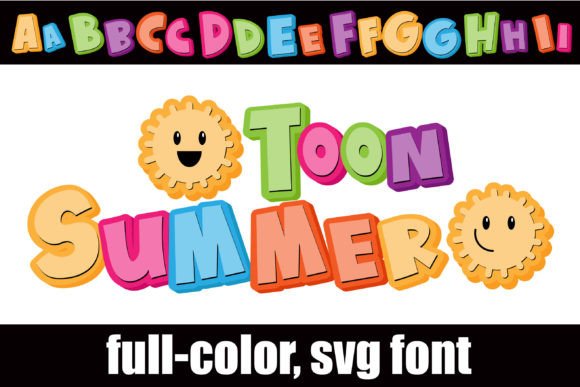
Sometimes a project doesn't need subtlety; it needs a shout. Whether you are designing a flyer for a local fair, creating a logo for a children's brand, or mocking up social media graphics for a summer sale, you need a typeface that brings the energy immediately. This is where a heavy, graphic font makes all the difference. Among the many options available in the realm of modern typography, few capture a specific vibe quite as effectively as a full-color SVG font. We are looking at a specific asset today that promises to bring a rainbow of personality to your canvas. It is a sans serif font that combines bold, toon-like shadowing with vibrant, embedded colors, making it a standout choice for display purposes.
The primary draw of this typeface is its visual weight and style. It features a "toon" aesthetic, meaning it has the rounded, heavy characteristics often found in comic books or animated titles. The shadowing gives the letters depth without requiring you to manually add drop shadows in your design software. However, the real magic lies in the color implementation. This is an OpenType full-color font, technically known as an SVG font. Unlike standard vector fonts that rely on the software to apply a single color, SVG fonts contain actual image data that allows for gradients, textures, and multiple colors within a single glyph. When you install this font, you are not just getting a shape; you are getting a pre-designed, multi-colored graphic element that scales beautifully.
Understanding the Technical Side of Color Fonts
If you are new to the world of color fonts, there are a few practical considerations to keep in mind to ensure your workflow remains smooth. A common point of confusion is compatibility. Because these fonts rely on specific technology to render the color data, they do not work in every single program. It is important to note that color fonts will typically show as black silhouettes in non-compatible software. Even in programs that do support them, such as Adobe Illustrator, Photoshop, Quark, or Silhouette Studio, you might see the font appear black in the preview window or font menu. You will only know for sure if the program can support the color data once you actually type on the document and see the letters appear in full color.
Installation is straightforward and follows the standard process for any .otf file. For Mac users, this usually involves opening the file in FontBook, while Windows users can install it via the Control Panel or their preferred font manager. For those using cutting machines for crafting, compatibility with Silhouette Studio is a huge plus. This allows crafters to use the font for vinyl decals or print-and-cut projects without losing the colorful aesthetic.
Furthermore, this font includes an "alt case" with additional colors. This is a clever feature that expands the font's versatility. You can access these alternate colors through your system’s character map or, more easily, through the glyph map in design software like Silhouette Studio. This allows you to mix and match colors within a single word, creating a chaotic, fun, and truly "toon" look. There is also a specific stylistic feature for the letter "s" or "suns." By typing the greater than and less than glyphs (the < and > symbols), you can trigger a special sun icon design, adding a thematic element perfect for summer campaigns.
Where to Use a Heavy Display Typeface
Because this is a heavy, stylized font, it is not intended for body text. You would not use this to write a paragraph in a newsletter. Instead, it shines brightest as a display font. Think of it as the "loudspeaker" of your typography toolkit. It is designed to grab attention instantly.
Branding and Logo Design: If you are launching a brand that targets a younger demographic or wants to convey a sense of fun and approachability, this typeface is an excellent candidate for a wordmark logo. For example, a summer camp, a toy store, a frozen yogurt shop, or a children’s party planner could use this font to establish an identity that feels playful and energetic right from the start.
Packaging Design: In the retail space, shelf appeal is everything. If you are designing packaging for a food product, a toy, or a seasonal item, a colorful display font can differentiate your product from competitors using standard serif or sans serif fonts. Imagine a bag of gummy candies or a box of popsicles; the rainbow coloring of this font instantly communicates sweetness and fun.
Social Media Graphics: The digital landscape is noisy. On platforms like Instagram or TikTok, you have a fraction of a second to stop a user from scrolling. A bold, colorful headline created with this font can act as a pattern interrupt. It is perfect for announcing sales, new product drops, or summer events. The high-contrast colors ensure that the text remains legible even on small mobile screens, provided the text is kept short and punchy.
Posters and Invitations: For print materials, this font excels in large formats. Event posters for carnivals, school events, or birthday invitations benefit from the "toon" aesthetic. It removes the need for complex illustration in the background, as the typography itself serves as the main visual attraction.
Pairing and Professional Presentation
One of the most valuable skills in design is knowing how to pair fonts. Because Toon Summer is so visually dominant, it requires a very quiet partner. If you try to pair it with another decorative font, such as a complex script or a handwritten font, the result will be visual clutter.
The best practice is to pair this colorful display font with a clean, neutral sans serif or a simple serif font for the supporting text. Think of fonts like Helvetica, Open Sans, Roboto, or Lato for the body copy. This contrast creates a hierarchy that guides the reader's eye. The bold, colorful font grabs their attention with the headline, and the clean font delivers the actual information clearly and legibly.
When considering readability, remember that the "toon" style is inherently playful, but the shadowing can sometimes obscure letterforms if the text is too small. Always use this font at a large size—typically 24pt or larger for print, and appropriately scaled for digital screens. If you are using it for a logo, ensure that the letters are spaced well so the shadows do not bleed into one another.
Commercial Use and Licensing
For entrepreneurs and small business owners, understanding the license behind a font is just as important as the aesthetics. Most premium fonts found on design marketplaces come with a commercial license, but the specifics can vary. Generally, you can use these fonts on physical products for sale (like t-shirts or mugs) and in digital marketing assets (like social media posts or website banners).
However, it is always your responsibility to check the specific End User License Agreement (EULA). Does the license cover the number of computers you plan to install it on? Does it allow for the creation of digital products where the font is embedded, such as a downloadable PDF? Since this font is a design asset that adds significant value to a project, ensuring you have the right to use it commercially protects your business from legal issues down the road.
In a market saturated with minimalist designs, there is a growing trend toward maximalism, nostalgia, and retro-futurism. Fonts that mimic the look of cartoons, comic books, and 80s/90s pop culture are making a major comeback. By incorporating a typeface like this into your toolkit, you are not just buying a font; you are buying a piece of visual communication that resonates with a desire for joy and color. Whether you are designing a flyer for a neighborhood block party or branding a new startup, having a bold, full-color option ready to go can save you hours of design time while delivering maximum impact.